The Badly Lit Municipality of Myself
LED: Light-emitting diode, the little modern light that now flickers over pharmacies, lanes, tea stalls, and human despair with equal democratic enthusiasm.
MFA: Master of Fine Arts, a graduate writing degree often blamed, sometimes unfairly, for turning ordinary suffering into polished decorative sadness.
B. F. Skinner: Burrhus Frederic Skinner, an American psychologist known for experiments on behavior, reward, punishment, and poor creatures pressing levers for food.
The drain outside my lane smells as if someone boiled a rat in old mustard oil, added two spoons of detergent water, stirred with a political promise, and then asked the municipality to inspect it after the next election.
This is not the Calcutta of postcards.
This is not the South Calcutta of cafés, softened old money, puja committees with taste, and aunties who can discuss Tagore, cholesterol, and your failed life with the same delicate spoon.
This is further down.
The southern edge.
The frayed hem.
The place where the city stops combing its hair.
After evening rain the lane shines, but not beautifully. It shines the way an old frying pan shines after too many omelets. Tyre dust, paan spit, dead flowers, plastic packets, detergent water, and a few mysteries from pipes that were apparently laid by men who regarded gravity as a foreign conspiracy.
A road, in theory, should take you somewhere.
This one mainly introduces you to dampness.
Half-built houses stand with iron rods poking out of their heads like thoughts that never became sentences. Balconies begin bravely and then lose interest. A shop appears wherever one man can fit one chair, one bulb, one ledger, one mobile charger, one jar of biscuits, and one suspicious face trained by life to ask the same four questions silently.
Who are you?
What do you want?
How much will you bargain?
And are you another educated fellow planning to speak of ethics while not paying full price for eggs?
I know this place too well.
That is the unpleasant part.
Because somewhere in the last few years, the inside of my head began to resemble it.
Not in the decorative MFA way, where every pothole becomes trauma, every tea stall becomes resilience, and every barefoot child becomes material for a conference in Europe.
No.
More like a municipal map drawn by a tired clerk who has given up lying.
The brain is often described as a miracle, which is convenient if you are selling incense, meditation apps, or motivational rubbish before breakfast. Mine feels less like a miracle and more like a badly run ward office. Files missing. Pumps slow. Wires exposed. One peon absent. One clerk angry. One fan rotating with the weary commitment of a man who knows the pension rules are against him.
In depression, the mind does not always collapse dramatically.
Sometimes it simply becomes under-serviced.
The lights dim. The drains clog. The memory lane gets waterlogged. A dog sleeps across the entrance of ambition. Somewhere a small shop called Hope remains open, but the owner has gone inside to count coins and cough.
Some places do not cause despair.
They merely remove the cover from it.
That is what this edge of Calcutta does. It does not ruin you by itself. It does something more irritating. It points. It says, look properly, dada. This is what was already there. Under the degree. Under the American years. Under the English sentences. Under the belief that education, sincerity, and hard work would eventually persuade life to stop behaving like a drunk contractor with missing receipts.
Here the unfinished is not a stage.
It is the style.
A building can remain half-plastered for ten years and no one blushes. A pavement begins for nine feet, then vanishes into mud like a man avoiding an old debt. A streetlight works just enough to prove that electricity is not a myth, only an unreliable relative. Cable wires hang overhead in black nests, each one belonging to some cablewallah, internetwallah, politicalwallah, buildingwallah, local empirewallah. When the wind shakes them, they look like the thoughts of a man trying to remember where he kept his last usable courage.
I walk here, when I walk, like a citizen of a country that has cancelled my passport but still allows me to buy onions.
Commerce is everywhere, but it is not cheerful. It is defensive commerce. Tea. Recharge. Photocopy. Eggs. Momo. Mobile cover. Welding. Blood test. Puja flowers. Second-hand tyres. Cheap biryani. Illegal parking. Life advice. Vape pens beside a poster of a god with the shoulders of a gym trainer.
Everybody is surviving.
That sounds noble until you watch it closely.
Survival is not always noble. Sometimes survival is rude, cunning, sweaty, petty, frightened, noisy, and busy scratching itself while explaining destiny.
There is a sentimental lie that poverty purifies people.
It does not.
Poverty often removes varnish. You see the plywood. You see the bargaining, the small cruelties, the panic under the smile, the cheating that is not always grand evil but small daily training. Press lever. Get pellet. Cheat customer. Pay rent. Flatter thug. Dodge bill. Feed child. Repeat until death arrives with a hospital estimate and a plastic chair outside emergency.
But let us not become fools in the other direction.
Wealth does not purify either.
Wealth only gives greed better shoes, an air-conditioned car, and the ability to say “process” while doing the same dirty thing from the twelfth floor.
The shopkeeper cheating ten rupees and the boardroom gentleman moving millions through paperwork are cousins. One smells of frying oil. The other smells of imported cologne and compliance training.
Same animal.
Different packaging.
I do not romanticize roughness because I live in it. Romance requires distance. Preferably a balcony. Preferably coffee. Preferably the option to leave.
When you cannot leave, the poetry becomes damp.
The generator coughing at night is not ambiance. It is invasion. The scooter horn is not local color. It is a metal insect entering the ear and laying eggs in the patience. The neighbor’s pressure cooker whistle is not homely. It is a scientific instrument measuring how close one middle-aged Bengali man is to becoming a small item on page five.
The pharmacy LED flickers blue-white on the puddles. For a second the lane looks almost important, like a crime scene in a low-budget detective serial. Then a man spits paan near a drain and the universe returns to its normal standard.
I have learned something from badly lit places.
They teach suspicion.
That man at the corner—is he waiting, watching, urinating, negotiating, or merely standing in the classic Bengali posture of unfinished irritation? That dog under the shutter—is it sleeping or dead? That sound behind me—is it a bicycle, a threat, or just another loose piece of civilization dragging itself home?
Suspicion becomes a local skill.
Like carrying change.
Like checking whether the milk packet is leaking.
Like knowing which fruit seller weighs with a thumb on the scale and which one does it only on spiritually weak days.
I have become locally adapted.
This is not growth.
It is camouflage.
My inner life has taken the color of unfinished cement. I answer less. I look down more. I keep my transactions small, my expectations smaller, and my tenderness wrapped in old newspaper like two stale singaras.
Inside me there was once another city. I am not joking. There were wide roads, libraries, clean rooms, long tables, research buildings, friends with oxygen in their voices, work that made sense, data that behaved, systems that did not need emotional bribery to function.
Now that city has encroachments.
Kiosks of worry.
Illegal balconies of regret.
A flyover of humiliation.
Under it, unpaid invoices sleep like drunk uncles.
There is no romance in bad infrastructure once it enters the personality.
A man becomes under-serviced.
First the drainage of grief clogs. Then the lights go. Then the inner roads are dug up for repairs that never begin. Then the police booth of self-control becomes unmanned after evening. Then some announcement comes from the loudspeaker: improvement is coming, funds sanctioned, tender floated, work order issued.
Twenty years later you are still stepping over the same emotional pothole in the same torn slipper, saying careful, careful, careful, as if caution were wisdom and not merely fear wearing spectacles.
Even my hope now looks like a small shop at the end of a bad lane.
One shutter half open.
One tube light.
One man inside counting coins.
There are days when the world outside continues as if nothing is strange. A cricket update comes on someone’s phone. A food delivery boy rides through ankle-deep water with the expression of a medieval messenger carrying bad news to a king. A child screams because childhood, unlike adulthood, still has the good manners to be loud about disappointment. Somewhere on television people debate national destiny while the drain outside my window conducts its own referendum.
The drain wins.
At fifty-one, the body also becomes a municipality.
This is not discussed enough.
The knee files complaints. The stomach forms a committee. The bladder, that punctual little tyrant, sends hourly notices at night. The teeth become separatists. The hair has already migrated. The skin develops policies of its own. You stand in the bathroom at 3:17 a.m. and urinate with the philosophical grandeur of a leaking tap, thinking: so this is civilization, then.
Somewhere a train passes.
Or a truck.
Or the gods dragging furniture in the flat above.
I am an atheist, so I do not blame gods. But I must admit they have excellent sound design.
The city does not sleep. It idles badly. The fan chops hot air into equal portions of disappointment. A mosquito finds my ankle with the accuracy of a military drone. My stomach makes a noise like a small committee rejecting reform.
And then comes the little truth.
Not a grand truth.
Not the kind printed on a calendar under a mountain.
Just a lane-sized truth.
The place outside and the place inside have reached an understanding.
The rough southern edge of Calcutta did not ruin me. I came with my own inventory of cracks. The city merely looked at me and said, ah, you too are half-built, underfunded, over-wired, badly drained, suspicious after dark, and full of unauthorized extensions.
Fair enough.
So I make tea.
This is my remaining ceremony.
Not a grand Darjeeling performance with silver strainers and moral superiority. Just a little pan, some milk, some tea, some sugar, and the mild risk of disaster. I burn the milk slightly, because even in small things I like to provide evidence against myself. A skin forms on top, that thin brownish membrane of optimism. I lift it with a spoon and throw it away.
Even my tea develops a surface it cannot defend.
Outside, a man shouts into his phone as if volume can defeat fate.
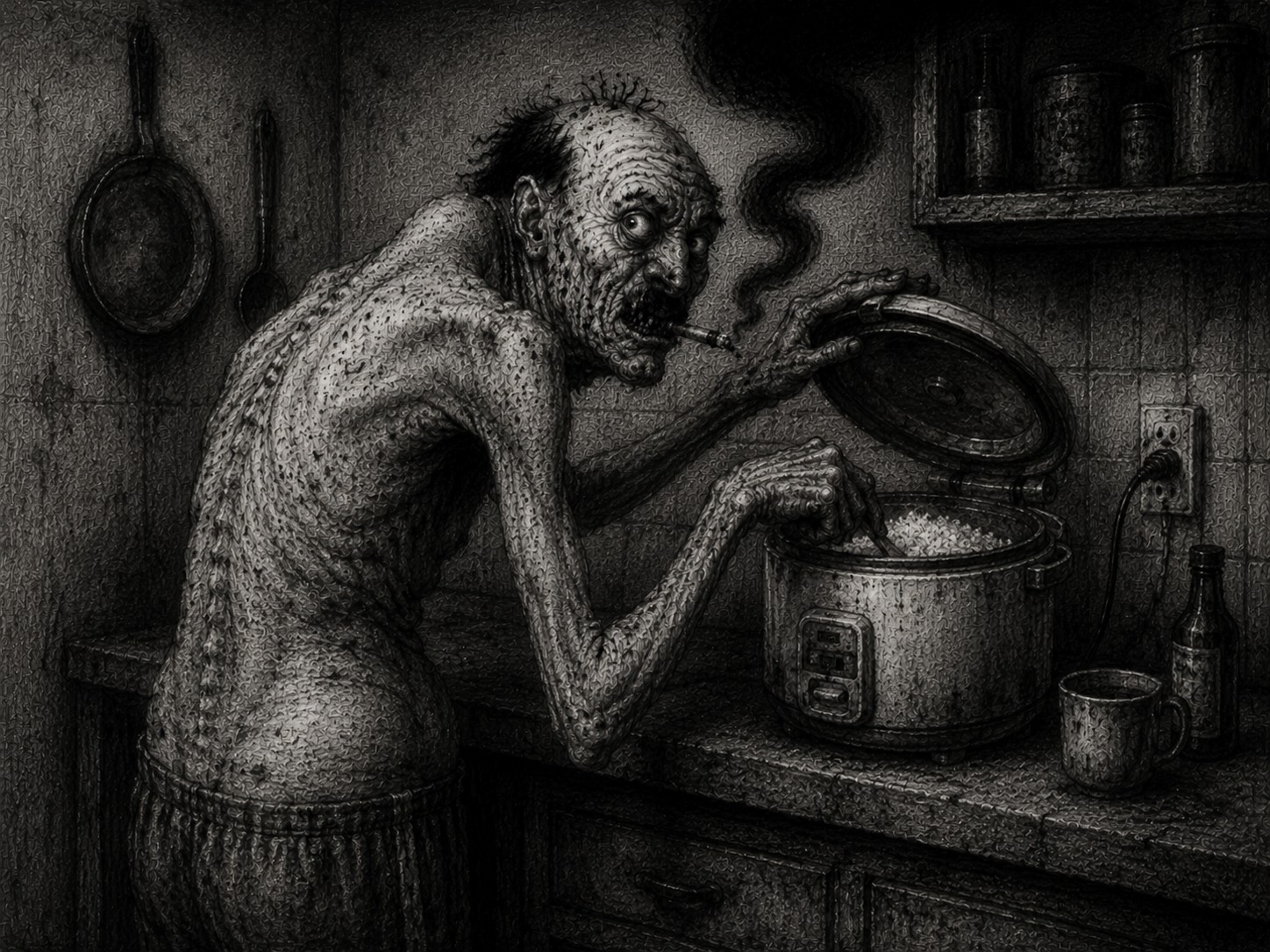
Inside, I scratch my belly, consider bathing, reject the proposal on administrative grounds, and sit in the badly lit municipality of myself.
The next power cut will come.
It always does.
And for a few minutes, everything will become honest.